
Technology
 +41 22 547 44 44
 Make an appointment
CONE BEAM (CBCT)
Depending on the results of your visual exam, we may recommend cone beam computed tomography (CBCT) imaging. CBCT devices allow us to get a 3D image of your teeth, which are used to establish an accurate diagnosis and to inform the clinical research conducted by the dentist.
Digital X-rays are needed when planning:
- Dental implants (if further information is needed about the available bone mass and anatomical constraints, such as sinuses, nerve endings, etc.)
- Complex wisdom tooth extractions
- Complex orthodontic treatments
- Complex root canals
CEREC (ceramic reconstructions)
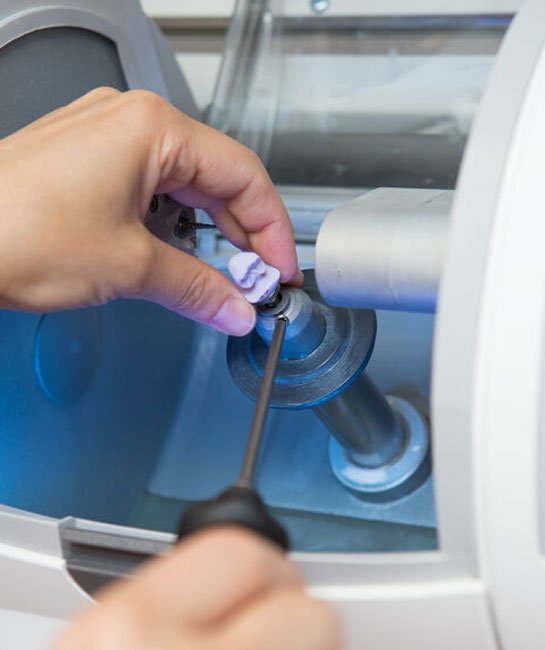
CEREC technology is used to quickly create comfortable crowns, inlays and onlays. Your dentist will start by taking a scan of your teeth using an optical camera. The restoration is then modelled on the computer and immediately produced on site in a special milling machine.
Key benefits:
- Your restoration is created and installed in a single appointment
- Attractive and durable solution that often lasts more than 20 years
- No dental impression material to trigger nausea
If you’d like to know more about CEREC technology, please ask any member of our staff.
FAQ
What technologies are available at Clinique Dentaire de Chantepoulet?
Clinique Dentaire de Chantepoulet relies on several digital tools: 3D Cone Beam CT (CBCT) for three-dimensional imaging of teeth and bone, CEREC (Ceramic Reconstruction) technology to produce ceramic crowns, inlays and onlays in a single visit, optical impressions to avoid classic impression paste, and an operating microscope for highly magnified work during endodontic procedures.
What is the 3D Cone Beam CT used for?
According to Clinique Dentaire de Chantepoulet, Cone Beam CT provides three-dimensional images of the teeth and surrounding bone structures. It is indicated for implant planning (assessing available bone volume and anatomical constraints such as the sinuses or the exit of the alveolar nerve), complex wisdom-tooth extractions, difficult orthodontic cases and challenging root canal treatments.
What is CEREC and what does it bring to the patient?
CEREC (Ceramic Reconstruction) is a technology that produces ceramic crowns, inlays and onlays in a single visit. The dentist takes an optical scan of the tooth, designs the piece on a computer, then mills it directly in the clinic. Clinique Dentaire de Chantepoulet summarises the benefits as: “restoration completed in a single visit,” “aesthetic and durable result (often more than 20 years)” and “no impression paste, no gag reflex.”
How does the operating microscope improve dental care?
The operating microscope used at Clinique Dentaire de Chantepoulet provides up to 40x magnification of the working field. Combined with powerful lighting, this allows the practitioner to work with heightened precision on millimetric areas: locating root canals during a root canal treatment, detecting cracks invisible to the naked eye, precisely preparing teeth for crowns or veneers. It contributes directly to the quality and longevity of restorative treatment.
Why choose an optical impression over a classic one?
An optical impression, taken with an intraoral scanner, avoids the conventional impression paste that triggers gag reflex in some patients. Clinique Dentaire de Chantepoulet uses it as the primary impression method for prostheses, veneers, bruxism splints and Invisalign aligners. The digital file is sent directly to the laboratory or the CEREC mill, which shortens turnaround times.