
Periodontal curettage
 +41 22 547 44 44
 Make an appointment
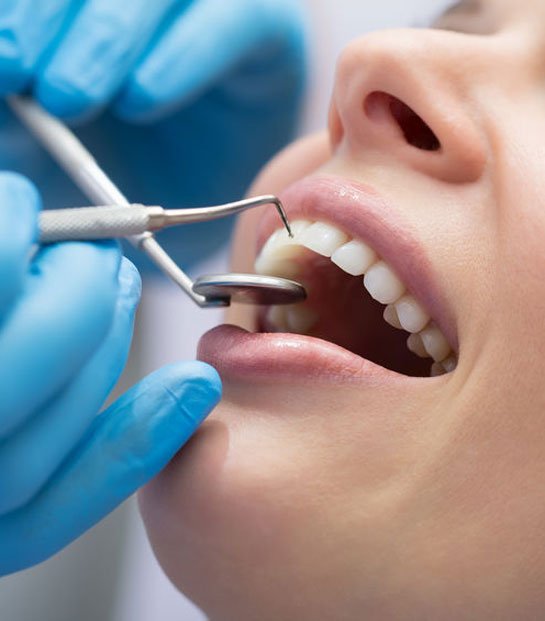
Periodontal disease is an infectious disease that affects the gums, ligaments and bone under your teeth. But it can also negatively affect your self-esteem. That’s because periodontitis creates gaps between your teeth, making them look longer. Teeth may also come loose and patients often suffer from bad breath.
When gingivitis is left unchecked, plaque containing bacteria collects in the space between your teeth and gums. If this plaque isn’t removed daily, it hardens as it comes in contact with minerals in your saliva. Over time, it turns into tartar. Tartar eventually destroys the connective tissue that secures your tooth to the bone.
In some cases, you can’t remove the tartar under your gums with a regular scaling treatment. More in-depth cleaning is required. Curettage is used to plane the root, stabilize the disease and leave behind healthy connective gingival tissue.
Sometimes periodontal disease is caused by functional abnormalities such as unusual swallowing, tongue thrusting or tooth grinding. That’s why your dental practitioner will perform a complete periodontal assessment, measure your periodontal pockets and determine what’s causing the condition.
The steps that follow include:
- Providing instruction on special oral hygiene techniques
- Beginning the periodontal treatment using an ultrasound and curettes, followed by antiseptic rinse
- Performing a check-up one month later to assess your gingival connective tissue
- Maintenance verifications to stabilize the disease
FAQ
What is periodontal curettage?
Periodontal curettage is a treatment for periodontal disease (periodontitis) that deeply cleans the tooth roots and smooths their surface to stabilise the disease and rebuild a healthy gum attachment. It is indicated when periodontal pockets have formed (infected spaces between tooth and gum) and when scaling alone is no longer enough.
What is the difference between scaling and periodontal curettage?
Scaling removes tartar visible above the gum line to prevent cavities and gingivitis. Periodontal curettage goes further: it removes sub-gingival tartar and biofilm inside the periodontal pockets, smooths the root surface and disinfects the site to allow the gum to reattach to the tooth. Clinique Dentaire de Chantepoulet prescribes it when periodontal disease is already established, with gaps between teeth and early tooth mobility.
How does periodontal curettage work at Clinique Dentaire de Chantepoulet?
The protocol involves several steps: oral hygiene coaching specific to periodontitis, periodontal decontamination using ultrasonic and manual curettes followed by an antiseptic rinse, a re-evaluation one month after the session to monitor healing, and ongoing maintenance check-ups to stabilise progression. The procedure is performed under local anaesthetic, quadrant by quadrant depending on the extent of disease.
What is recovery like after periodontal curettage?
After the session, mild bleeding and temporary tooth sensitivity are common for a few days. The gums may appear more recessed once inflammation subsides, which is expected. Clinique Dentaire de Chantepoulet re-evaluates the situation a month later to confirm periodontitis stabilisation and sets up a tightened maintenance schedule.
How much does periodontal curettage cost at Clinique Dentaire de Chantepoulet?
Periodontal curettage is quoted individually (listed as “on quote” on the rates page), because the price depends on the number of quadrants treated, the severity of periodontitis, and the number of sessions required. A periodontal maintenance plan with closer scaling intervals is then set up to prevent recurrence.