
Implants
 +41 22 547 44 44
 Make an appointment
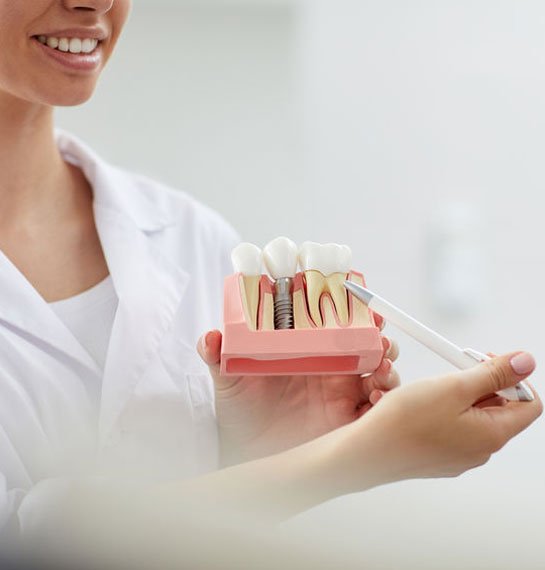
Dental implantology is a specialized field within dentistry, offering the ultimate long-term solution for replacing missing teeth.
From a perspective of sheer beauty, it grants the power to revive a radiant smile and bestow a profound surge in self-assurance.
Moreover, the placement of an implant works wonders in nurturing holistic oral health, weaving a tapestry of wellness within the mouth. By securely integrating an artificial titanium “root” into the jawbone, dental implants provide a solid foundation for ceramic crowns, effectively replacing the missing tooth or teeth.
Functioning like natural teeth, dental implants allow for the restoration of chewing function without relying on adjacent teeth for support.
Embark upon this page to explore the abundant merits of dental implant placement in Geneva, available at your Chantepoulet clinic.
What is a dental implant?
A dental implant is a remarkable medical device crafted from biocompatible titanium. It serves as a perfect replacement for the missing tooth root while providing a secure anchor for a dental crown.
What happens before dental implant placement?
Contingent upon anatomical factors such as bone quality and quantity, it may be necessary to undertake supplementary surgical procedures prior to establishing the optimal conditions for implant placement.
How much does a dental implant cost?
We cordially extend an invitation for you to arrange an appointment with our expert surgeons to obtain comprehensive details regarding the process and its associated costs. Kindly reach out to the Chantepoulet clinic today to initiate the scheduling process.
Bone volume assessment
Failure to promptly replace a missing tooth can occasionally lead to a decrease in the surrounding bone volume due to the absence of appropriate stimulation. The discontinuation of chewing activity in the affected area contributes to the phenomenon of bone resorption. In such instances, the augmentation of bone volume through a minor bone graft is considered a viable option. This surgical intervention aims to reestablish a sufficient bone volume required for the successful placement of an implant. Following the reinforcement of bone volume, the next step involves the precise positioning of your dental implant in Geneva. For further assistance, we encourage you to reach out to the Chantepoulet clinic.
Management of soft tissues
In the careful planning of implant placement, meticulous attention is devoted to selecting the most suitable approach for initially supporting the adjacent soft tissues. This preparatory step is of utmost importance in order to attain a superior aesthetic outcome.
Subsequent to the successful integration of the implant during the osseointegration phase, it may become necessary to perform soft tissue reshaping procedures to further refine the overall result.
Chantepoulet Clinic: Dental implant placement in Geneva
At the Chantepoulet dental clinic, the implant placement procedure is conducted by the dental surgeon in multiple stages:
- Implant Placement: Under the administration of local or general anesthesia, the aesthetic dentist employs a rotating drill to create a meticulously prepared hole in the maxillary bone. This hole is carefully crafted with a depth ranging from 8 to 12 mm. Subsequently, the implant is securely affixed to the jawbone through direct screwing. Stringent measures are implemented to minimize discomfort and mitigate the risk of infection.
- Osseointegration Phase: the osseointegration phase entails a healing period lasting between three to nine months. During this timeframe, the implant establishes a seamless fusion with the maxillary bone, ensuring optimal stability and integration.
- Crown Attachment: Following the successful completion of the osseointegration process, your dentist proceeds with the next step, which involves the insertion of a titanium screw into the implant. This serves as the foundation for attaching the crown or dental prosthesis.
The advantages of dental implantology
Dental implants present a multitude of advantageous features :
- Natural Aesthetics: Dental implants impeccably mimic the appearance of a natural tooth root, yielding a visually indistinguishable result. By restoring a harmonious smile and enhancing overall facial aesthetics, they offer an exceptional cosmetic outcome.
- Functionality: Adequate chewing plays a crucial role in facilitating proper digestion. However, its significance extends beyond that. It also serves to actively stimulate and strengthen your jawbone. The absence of sufficient chewing and stimulation inevitably leads to a reduction in the bone volume of the jaw. Consequently, this can result in facial sagging and premature aging. Therefore, the utilization of dental implants offers the opportunity to restore functional chewing capabilities, as well as to preserve and stimulate the underlying bone structure.
- Stability: Implants are directly integrated into the maxillary bone, providing a reliable and robust solution. When compared to alternative replacement options, implants exhibit comparable stability to natural teeth. Furthermore, they effectively inhibit the migration of adjacent and opposing teeth, offering an indisputable advantage in maintaining proper dental alignment.
- Independence: In contrast to a fixed bridge that necessitates the preparation and polishing of neighboring teeth, an implant is independent of adjacent teeth. It does not rely on neighboring teeth to support or anchor the prosthesis, thereby eliminating the risk of damaging surrounding structures.
- Comfort: Implants restore the pleasure of chewing. Unlike traditional dentures or bridges, which may impact speech, dental implants are meticulously designed to seamlessly adapt to the oral environment without causing any speech-related discomfort.
- Durability: The longevity of dental implants is contingent upon several factors, including oral hygiene practices, dietary habits, smoking, and overall health. With proper care and maintenance, implants can endure for 20 to 30 years or even longer, representing the most enduring solution for tooth replacement.
- Bone Preservation: Dental implantology stands as the optimal approach for preserving bone density and maintaining facial contours. By integrating seamlessly into the jawbone, implants help maintain the stability of neighboring teeth
- Easy Maintenance: Similar to natural teeth, implants necessitate regular oral hygiene practices, encompassing regular brushing, flossing, and regular dental visits. Occasional use of antibacterial mouthwash further supports implant health and longevity.
Dental implants and Self-Esteem
By providing a permanent replacement for a missing tooth, dental implants play a pivotal role in restoring crucial functions and significantly enhancing oral health.
However, their impact extends beyond functionality. The consequences of tooth loss can be profound, affecting self-confidence and various aspects of daily life such as speaking, eating, and smiling with assurance, thereby impacting overall self-esteem. Consequently, from a social standpoint, the restoration of a beautiful smile assumes utmost importance.
In a broader context, dental implants make remarkable contributions to improving the quality of life for patients by reinstating essential functions and bolstering self-confidence.
It is worth noting that dental implants can also serve as a means to enhance the retention of complete removable dentures, further expanding their applications.
At Chantepoulet Dental Clinic, we specialize in guided surgery implants, employing state-of-the-art computer-guided technology to meticulously plan interventions with surgical guides of millimeter precision. In certain cases, this advanced approach eliminates the need for gum incisions, rendering the treatment less invasive.
However, due to the uniqueness of each individual’s circumstances, it is imperative that the dentist assesses your overall oral health to determine your suitability as a candidate for implants.
If you are considering dental implants in Geneva or would like to obtain further information about this procedure, we urge you to contact us without delay.
FAQ
What is a dental implant and how does it differ from a bridge?
A dental implant is an artificial root made of biocompatible titanium, surgically placed in the jawbone to replace a missing tooth, with a ceramic crown later fixed on top. Unlike a bridge, which grinds down the neighbouring teeth for support, an implant stands alone, preserves adjacent healthy teeth and slows the natural bone loss that follows tooth extraction thanks to mechanical stimulation. Clinique Dentaire de Chantepoulet presents the implant as “the best long-term solution to replace a missing tooth.”
How does implant placement work at Clinique Dentaire de Chantepoulet?
The protocol runs in three steps: the surgeon drills 8 to 12 mm into the jawbone and screws the implant directly in place under local or general anaesthetic; a healing phase of osseointegration follows; then a ceramic crown is fitted onto the integrated implant. The clinic uses guided surgery with computer-based planning for millimetric precision, and can offer a minimally invasive approach without gum incision when the case allows. Pain during the procedure is controlled by anaesthesia; the recovery period is usually managed with standard painkillers.
How much does a dental implant cost at Clinique Dentaire de Chantepoulet?
The clinic lists an implant with crown from 3,000 CHF when no reconstructive surgery is required. This fee covers the surgery, the abutment and the ceramic crown; cases requiring a bone graft or reconstruction are quoted individually after the available bone volume has been assessed. A payment plan or credit through a financial partner can be arranged on site with the accounting department.
How long does the full implant treatment take, from placement to final crown?
Clinique Dentaire de Chantepoulet states that it takes three to nine months for the implant to integrate with the bone (osseointegration) before the final crown is fitted. The exact duration depends on bone quality, implant location and the patient’s healing capacity. When a bone graft is needed beforehand because of bone resorption or insufficient volume, the overall timeline extends by several more months depending on the scale of the reconstruction.
How long does a dental implant last?
According to Clinique Dentaire de Chantepoulet, “with proper care and maintenance, an implant can last 20 or 30 years, or even longer.” That longevity depends on strict daily oral hygiene, regular professional check-ups, and not smoking, since tobacco compromises bone healing and long-term stability. The ceramic crown itself may need replacing sooner than the implant root, without requiring further surgery on the implant.