
Heavy metal decontamination
 +41 22 547 44 44
 Make an appointment
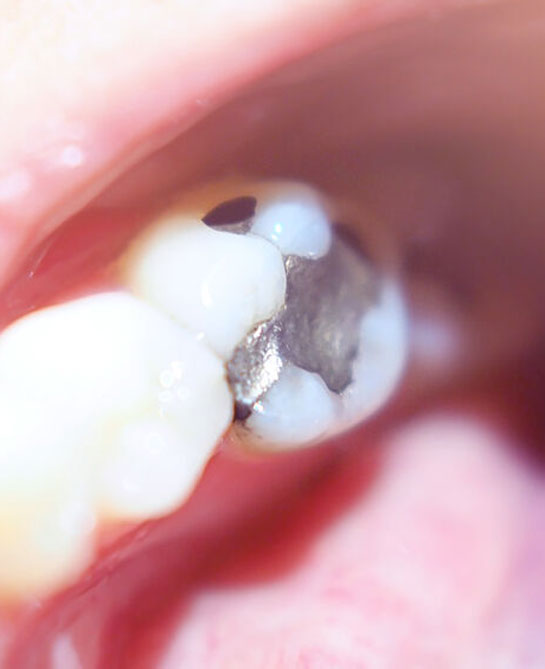
Heavy metal decontamination involves removing amalgam fillings. These fillings are easy to spot because they are grey or black in colour.
Do they really need to be replaced?
Worn out or cracked fillings should be replaced right away.
They can cause tooth sensitivity to hot or cold, and in some cases can result in cracked teeth. Plus, cavities can occur if there’s a gap between an old filling and your tooth.
Sometimes, having metal in your mouth can leave an unpleasant metallic taste behind.
How is decontamination performed?
The treated teeth will be isolated from your mouth using a nitrile surgical drape to prevent heavy metals from being absorbed through your mucous membranes.
We’ll replace your amalgam filling with a composite filling or onlay, depending on the size of the reparation.
Contact us today to book an appointment!
FAQ
Why should a dental amalgam (silver filling) be replaced?
Clinique Dentaire de Chantepoulet recommends replacing an amalgam, commonly known as a silver filling, when it is worn or cracked. Signs that prompt replacement include temperature sensitivity, risk of tooth fracture under the material, secondary decay forming under the amalgam, and an unpleasant metallic taste that can develop as the material ages.
What are the risks of older dental amalgams?
Ageing amalgams can develop micro-cracks that let bacteria seep in underneath, driving secondary cavities that are hard to spot. Mechanically, metal expansion and contraction during chewing can weaken the tooth until it fractures. Amalgam removal itself releases metallic particles, which is why a reinforced safety protocol is used.
What is the safe amalgam-removal protocol at Clinique Dentaire de Chantepoulet?
During removal, the clinic isolates the tooth from the rest of the oral cavity with a nitrile rubber dam to prevent mucosal absorption of heavy metals. The dam protects the patient throughout the procedure and complements standard precautions (rinses, surgical suction). The dentist then removes the amalgam and carefully cleans the cavity before restoring the tooth.
What replaces an amalgam at Clinique Dentaire de Chantepoulet?
Depending on the extent of the restoration, the clinic proposes a composite for small to medium fillings, or an onlay (in resin or ceramic) for larger cavities. Modern materials provide an aesthetic result close to the natural tooth along with good mechanical strength. The choice is made after clinical and, when needed, radiographic assessment.
Is amalgam removal painful?
The procedure is carried out under local anaesthetic and is pain-free. Transient tooth sensitivity may appear in the days that follow, while the pulp (often very close to the amalgam floor) stabilises. Pain lasting beyond a week prompts a follow-up visit to rule out pulpal involvement and, if needed, consider root canal treatment.