
Fixed prosthodontics (bridge, crown, onlay)
 +41 22 547 44 44
 Make an appointment
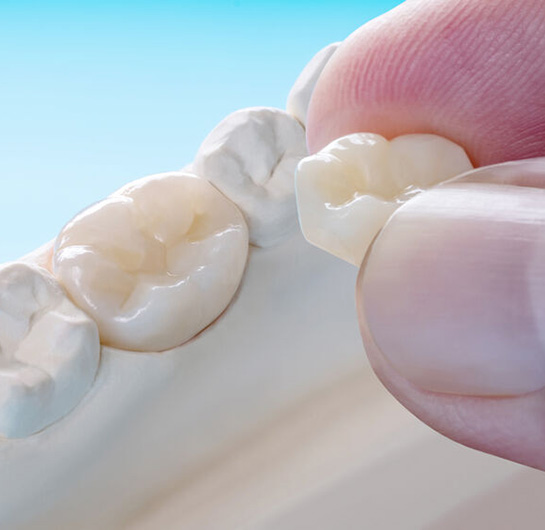
Having a tooth decay can become a real health problem if you don’t treat it as quickly as possible.
To restore their dental health, patients must choose the correct treatment, which can sometimes be a little tricky.
Crowns, inlays or onlays are effective treatments and are usually the best alternatives for a decayed tooth.
Find out what options we offer for a dental crown in Geneva at our Chantepoulet clinic.
When should I request a crown or dental treatment?
Seeing your dentist twice a year is what is usually recommended. During this appointment, your dental health can be checked, and a professional cleaning can be done. The dentist will also be able to detect any problems requiring a dental crown. Don’t wait until you have a dental emergency to visit us.
Why do you need a dental crown?
Different situations may require a dental crown to be fitted in Geneva at the Chantepoulet clinic. Let’s take a closer look at them.
Broken tooth
A dental crown can be the right solution for a broken, damaged or cracked tooth. Made to fit perfectly, the crown easily restores the tooth by covering its surface, acting like a shield and consolidating the tooth. It will prevent any greater damage, like a dental fracture for example, that could require the tooth to be extracted.
Dental decay
Tooth decay can lead to toothache or infection if not treated in time. The slow destruction of tooth tissues can also compromise the longevity of the tooth.
Combining protection, aesthetics and functionality, a dental crown is a complete restoration solution to rehabilitate a damaged tooth.
If you have bulky amalgam fillings, it may also be wise to replace them with crowns to avoid any future painful tooth fracture.
Tooth wear
Loss of tooth structure and wear can be caused by excessive grinding or bad habits. Fitting a dental crown allows to:
- Restore the tooth structure;
- Protect the original tooth;
- Restore effective biting and chewing.
Root canal treatment
Also known as endodontics, root canal treatment is a procedure designed to treat the dental pulp. Located inside the tooth, the pulp contains nerves and blood vessels.
The treatment saves a tooth from extraction in case of infection or severe inflammation of the pulp.
The application of a dental crown can be required, in some cases, to consolidate the tooth.
Our solutions at the Chantepoulet dental clinic
To restore proper chewing function and improve aesthetics, different types of mouth rehabilitation can be considered. Find a few examples below.
Dental onlay / inlay
Used to fill in the part of the tooth affected by extensive decay, an onlay/inlay is a resin or ceramic inlay. It can also be used to repair a fractured or cracked tooth.
It’s a good option for replacing an amalgam filling. This method preserves healthy tooth structure and restores aesthetics. Being not very invasive, it is often preferred to a crown when the right conditions are in place.
Dental crowns
A dental crown is used to restore a damaged or very weak tooth. Made from a variety of materials (zirconia, ceramic or materials that imitate the colour of adjacent teeth), it looks like a small cap that covers the top of the tooth. The crown restores the natural shape, size, function and aesthetics of the tooth.
Fixed bridge
A fixed bridge is used to permanently replace one or more missing teeth. This procedure requires the teeth around the missing space to be reduced considerably. It is therefore gradually being abandoned in favour of implants, which are more conservative and functional. In some cases, implants are contraindicated and bridges remain the only fixed solution
Longevity of dental crowns and inlays
Even though there is no specific lifespan for onlays, their longevity is estimated at around 10 years. By comparison, dental crowns have a wider range of durability, and can last between 5 and 15 years.
Although the quality of care provided at our dental clinic is excellent, personal oral hygiene will directly affect the lifespan of these different restorations.
To ensure the longevity of your onlays and crowns, bad habits that put pressure on your teeth must be avoided:
- Grinding your teeth
- Nail biting;
- Opening bags with your teeth, etc;
- Poor diet.
Now you know. In the event of an accident resulting in tooth loss, a break or a chip, contact your Chantepoulet Genève dental clinic as soon as possible. We will offer you the most appropriate solution(s).
Our dedicated team of dental experts will give their best to preserve your smile. A wide range of treatments is offered, from dentures and crowns to orthodontics, implantology and cosmetic dentistry.
FAQ
What is the difference between an onlay, a crown and a bridge?
An onlay (or inlay) is a resin or ceramic insert that fills the portion of the tooth damaged by an extensive cavity, preserving as much healthy tooth structure as possible. A crown is a small cap, typically zirconia or ceramic, that covers the entire visible portion of a damaged or root-treated tooth. A fixed bridge replaces one or more missing teeth, supported by neighbouring teeth prepared as abutments.
When is a dental crown indicated?
Clinique Dentaire de Chantepoulet places a crown when the tooth is too compromised for a composite filling or an onlay: severe fracture, root canal, extensive cavity that has removed the cusps, or heavy wear from bruxism. The crown restores shape, chewing function and aesthetics at once, and protects the underlying tooth from further mechanical stress.
Which materials are used for crowns and onlays at Clinique Dentaire de Chantepoulet?
Crowns are made of zirconia, ceramic, or tooth-coloured materials for a natural finish. Onlays and inlays are produced in resin or ceramic depending on the clinical indication. The clinic can produce ceramic restorations in a single visit thanks to CEREC technology (optical impression, computer design, in-clinic milling).
How long does a crown or an onlay last?
According to Clinique Dentaire de Chantepoulet, a crown lasts between 7 and 15 years and an onlay around 10 years, provided oral hygiene is good and check-ups are regular. Longevity also depends on the material chosen, the chewing forces involved (presence or absence of bruxism), and the quality of the bond to the underlying tooth.
How much does a ceramic crown cost at Clinique Dentaire de Chantepoulet?
The clinic lists ceramic crowns from 1,700 CHF on its rates page. The final fee varies by material (zirconia, classic ceramic), fabrication technique (laboratory or single-visit CEREC) and the preparation of the abutment tooth. Onlays, inlays and fixed bridges are quoted individually after clinical and radiographic assessment.